The Six Types of Gutter Guard, and What Each One Actually Does
Start here
One Category, Six Constructions
Ask three contractors about gutter guards and you will get three different products, three different names for those products, and very little agreement about which belongs on your house. Some of that is marketing. Most of it is that “gutter guard” is a category rather than a thing, and the six constructions inside it work in genuinely different ways.
Short answer. There are six broad types: brush inserts, foam inserts, solid covers, coarse mesh screens, micro-mesh, and reverse-curve. They differ in what size of debris they stop, how much water they pass in a downpour, and how much attention they want afterwards. What matters here is not which is best in general — it is which suits your trees, your roof and your winter.
The words
Why the Names Are So Confusing
Before the types, a word about the words, because this is where most homeowners lose the thread.
| Eavestrough or gutter | The trough along the edge of your roof is an eavestrough in Canada and a gutter almost everywhere else. Both are correct, and you will hear both from people working on the same house on the same day. |
|---|---|
| Guard, cover or screen | The covers that go over it get called gutter guards, eavestrough guards, leaf screens, gutter covers or eavestrough screens, more or less interchangeably. |
| Trade names | Then there are trade names. Several manufacturers have branded their systems with names that sound like categories, and homeowners repeat them back as though they were. A brand name tells you the make; it does not tell you the construction, and the construction is what decides how the thing behaves on your roof. |
| What to ask instead | So when you are getting quotes, ignore the name on the box and ask a different question: what is the opening size, and what happens to the water in a heavy downpour. Two products with completely different names may be the same construction, and two with similar names may not be. |
The six types
The Six Types
Brush inserts
A long cylindrical brush that sits down inside the trough, bristles up. Leaves land on the bristles and, in theory, blow off; water runs through underneath.
It is the simplest system there is. The weakness is that the brush becomes the debris: needles and small seeds work into the bristles and stay there, and eventually you are pulling the brush out to clean it rather than cleaning the trough. On a house with spruce over the roof, brush disappoints soonest.
Foam inserts
A wedge of open-cell foam that fills the trough. Water passes through the foam; debris rides on top.
Same appeal as brush, and a similar limitation. Foam holds grit and holds moisture along with it, and in a climate that freezes and thaws repeatedly through one winter, a saturated foam wedge in a trough is not doing you a favour. Seeds also germinate in it, which sounds like a joke until you see maple seedlings along somebody’s roofline.
Solid covers
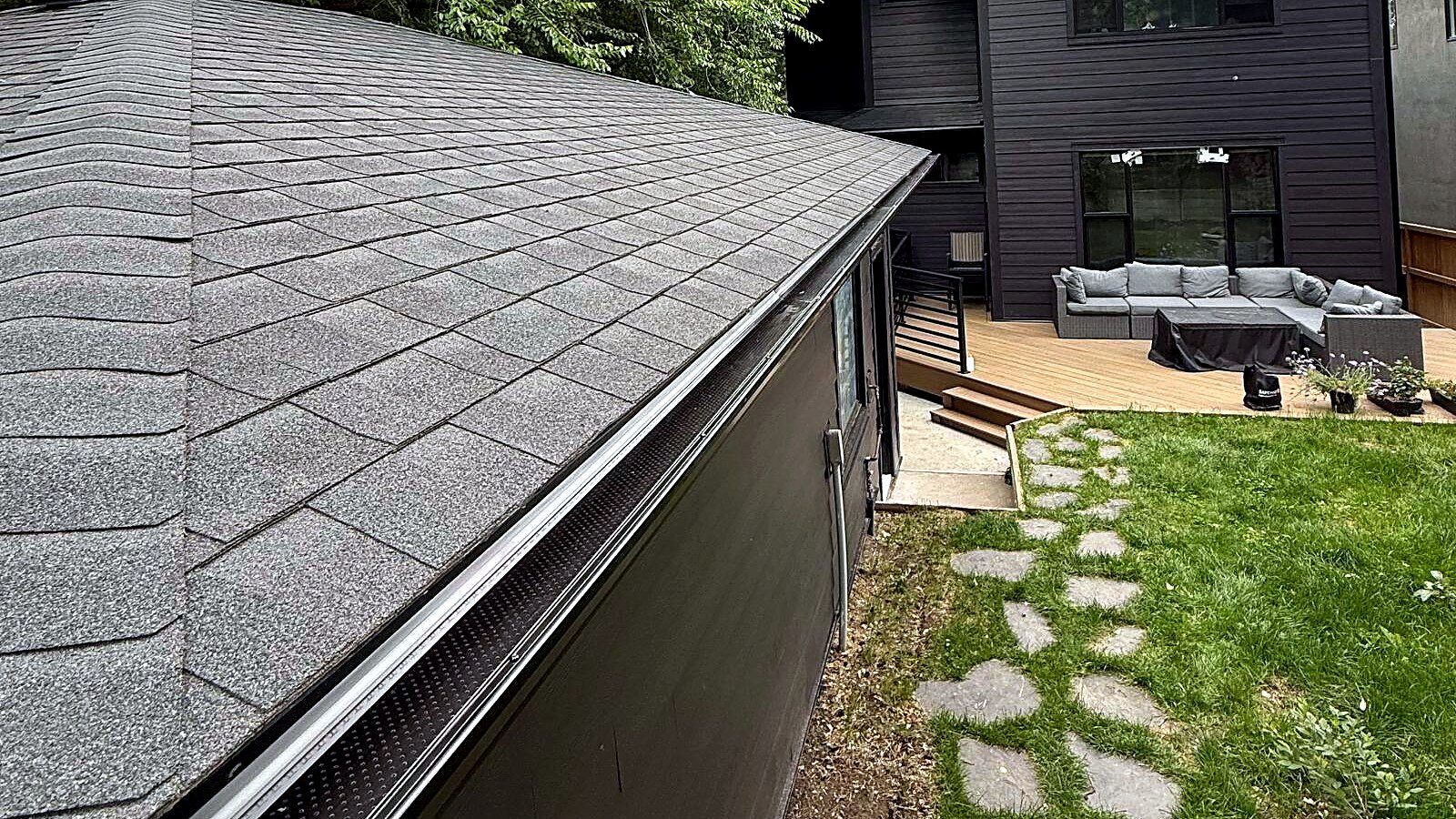
A rigid cover, aluminum or PVC, that closes the top of the trough and admits water through perforations or slots. The version with small punched holes across an aluminum face is the most common “standard” guard in Canada.
Solid aluminum covers handle this climate well: aluminum does not go brittle in cold the way PVC can, and a rigid cover carries wet snow without deforming. The variable to ask about is perforation size — large enough to move water quickly in a downpour, small enough that needles and granules do not simply pour in. Those two goals pull against each other, which is why perforation patterns differ so much between products.
Coarse mesh screens
A screen with visible openings, laid into or clipped over the trough, usually aluminum or steel.
Mesh screens stop leaves reliably and cost less than fine-mesh systems. What they do not stop is anything smaller than the openings — spruce needles, maple keys, and the granules every asphalt roof sheds as it ages. On a lot with deciduous trees only, a coarse screen is often the sensible answer. Under conifers, a partial one.
Micro-mesh
A fine stainless or aluminum mesh, usually stretched over a rigid frame, with openings small enough to exclude needles and shingle granules.
This is the type most often confused with the one above, and the distinction is the most important on this list: micro-mesh is the only construction that reliably keeps fine debris out of the trough. The trade-offs are cost, and that the mesh itself needs occasional attention — pollen, dust and fine grit build into a film on the fabric, and water then runs over the mesh instead of through it. Being told a micro-mesh system will never need touching is a claim to be sceptical about.
Reverse-curve
Also sold as surface-tension systems, and referred to colloquially as helmets. A curved nose closes the trough, water clings to the curve and follows it around into a narrow slot, and debris carries on past the edge and falls to the ground.
It works on real physics and it handles leaves very well. The considerations: the curve is visible from the ground and changes the look of the roof edge, heavy wind-driven rain can overshoot the slot, and the same narrow slot that admits water can be blocked by fine grit over time. It is also the type most dependent on installation angle — fitted a few degrees off, the effect it relies on stops working.
Fitting
How They Go On, and How Long It Takes
Almost nobody describes this part before the invoice arrives, so here it is. A guard is fitted to the eavestrough, not to the roof — but how it attaches to the trough is the decision that matters most, and there are three ways to do it.
| Under the first course of shingles | The back edge of the guard slides beneath the bottom row of shingles. It sits flat and looks tidy, and it is the method most likely to cause an argument later, because lifting shingles that were not meant to be lifted is the one thing that puts a roof warranty in question. On a newer roof this is worth a conversation before anyone touches it. |
|---|---|
| Clipped or screwed to the front lip | The guard fastens to the outer edge of the trough and rests on the back wall without going near the roof. Nothing touches the shingles, which is why we prefer it on a roof still under warranty. It relies on the trough being straight and properly hung, because the guard now spans it. |
| On brackets inside the trough | Support brackets sit in the trough and carry the guard from below. Used with heavier covers and on wider runs. It puts weight into the hangers, so the hangers get checked first and replaced if they are tired. |
That first row is the reason we ask about the age of your roof before we quote a guard. Most shingle manufacturers write their warranty around the roof being left as installed, and a guard tucked under the shingles is a change to it. We would rather raise that with you at the measure than have you discover it during a claim. If the roof is new, we will usually recommend one of the other two methods even when the first would look neater.
The trough gets cleaned out
Nothing goes on over a season of debris. Whatever is in there comes out, and the inside of the trough gets looked at while it is empty — the last time anyone will see it for a while.
Fall, hangers and outlets get checked
Spacing of the hangers, the fall toward each downspout, whether the outlets are sized for the roof feeding them. A guard on a trough that does not drain properly hides the problem instead of fixing it, and the water still comes over the front.
The fascia behind it gets a look
If the board the trough hangs on has gone soft, that is the job, and a guard is not it. Covering a system hung on failing fascia adds load and puts a lid over the evidence.
Ends, corners and outlets get closed off
Inside and outside corners, the end of every run, the mouth of each downspout. These are where debris gets in when the straight sections are done well and the awkward ones are not.
How long it takes depends on the length of the runs, how many corners and downspouts there are, and how much of the trough needs putting right first. On most houses it runs alongside eavestrough work rather than as a separate visit. One thing worth knowing at the start: if the fascia ever needs replacing, the trough comes off, and the guard comes off with it. That is not a reason to skip guards — it is a reason to deal with soft fascia first, while the trough is already down. If your eavestroughs are also due, our seamless eavestrough installation in Calgary and Airdrie covers both in one visit.
Alberta factor
What Alberta Does to All of Them
Everything above is true anywhere. Here is what is specific to this part of the country.
| Chinooks | A midwinter thaw sends a large volume of meltwater off a warm roof into a trough that may still be frozen at the bottom. Any guard has to move water quickly during those hours, and systems relying on a narrow entry point are the ones most likely to be overwhelmed. |
|---|---|
| Freeze-thaw | Water that sits in a system and freezes expands, and it does that dozens of times over a season. Materials that absorb and hold water — foam in particular — have a harder time of it here than in a milder place. |
| Snow load | Wet spring snow is heavy. A rigid guard carries it; a screen that flexes, or a lightweight insert, may deform and never quite recover its shape. |
| Shingle granules | Alberta roofs take hail, and hail accelerates granule loss. Those granules end up in the trough. If your roof is in the second half of its life, granule size is a more useful thing to think about than leaf size. |
Type by type
The Same Six Types, Through an Alberta Winter
The table above is what this climate does to eavestroughs generally. Here is the same winter run against each of the six constructions in turn, so you can compare them on the same four questions rather than on the manufacturer’s favourite one.
| Brush inserts | Water passes freely, which is the point, and the bristles hold fine debris that then freezes into a solid core. In a chinook the melt has to travel through that core. Easy to pull out and rinse, which is the honest argument for them here. |
|---|---|
| Foam inserts | Foam absorbs and holds water, and held water freezes and expands, dozens of times a season. This is the construction the freeze-thaw cycle is hardest on, and the one most likely to need replacing rather than cleaning. |
| Solid and reverse-curve covers | Water is meant to cling around a curved lip into a narrow slot. That slot is a small target for a chinook volume coming off a warm roof, and it is the first thing to skin over with ice. Rigid enough for wet spring snow, which is the trade. |
| Perforated aluminum covers | Rigid, carries snow load, and the open area is spread across the whole cover rather than concentrated at one entry point, so a sudden melt has somewhere to go. Holes large enough to pass granules from an ageing asphalt roof. |
| Mesh screens | Coarse enough to shed leaves and cheap enough to fit a whole house. The frame is what matters in this climate: a screen that flexes under wet spring snow can deform and never quite sit flat again. |
| Micro-mesh | The only construction that stops shingle granules and conifer needles, which is why it exists. The fine surface is also the one that ices over soonest and blocks with pollen and fine dust, so it is a choice about what lands on your roof, not an upgrade for everyone. |
Honest limits
What No Guard Will Do for You
Guards are often sold on promises they cannot keep.
| No guard stops ice | Ice at the roof edge forms because heat escaping into the attic melts snow, which refreezes where the roof is cold. That is an insulation and ventilation problem, solved at the soffit and in the attic. A guard on a frozen eavestrough is a frozen eavestrough with a lid. |
|---|---|
| No guard makes the system maintenance-free | Every construction here needs looking at from time to time. Guards change how often, not whether. |
| No guard fixes a trough that is hung wrong | If the fall toward the downspouts is off, or the outlets are undersized for the roof area feeding them, water overflows with a cover on it exactly as it did without one. |
| No guard fixes soft fascia | If the wood behind the trough has gone, that is the job — and fitting guards to a system hanging on failing fascia adds weight to the problem and hides it from view. |
The slow version
What Happens to an Eavestrough Nobody Touches
The reason any of this matters is not tidiness. An eavestrough that stops working does not fail loudly; it fails in an order, and each stage costs more than the one before it.
One season — it stops being a trough
Packed debris holds water instead of moving it. From the ground the run looks the same as it always did, which is why this stage passes unnoticed.
First year — water comes over the front
Not in drips, in a sheet, down the fascia and off the ends of the run. In summer you see it in a downpour. In winter you see it as an ice ridge along the eave.
Second year — the board goes soft
Painted wood that never gets a chance to dry rots from the back. By the time paint is lifting on the face of it, the board behind has been going for a couple of seasons. That is rotted fascia and the board the trough hangs on, and it is now a carpentry job.
Two to three winters — ice, weight, and the run comes down
Wet debris is heavy and frozen debris is heavier. Hangers pull, seams open, and a run lets go in a spring thaw taking part of the fascia with it. Meanwhile roof water has been landing at the base of the wall all along, and Alberta clay moves with that.
None of that is an argument for guards specifically. It is an argument for the trough being looked at, which a guard makes less frequent but does not replace — a neglected trough with a guard on it reaches the same end, just slower. If you are already seeing the first two stages, the useful reading is 5 signs your eavestroughs need replacing.
Your house
Which One Suits Your House
The useful question is not which type is best. It is what is landing on your roof.
WHERE GUARDS EARN THEIR KEEP
- Deciduous trees, leaves only: a coarse mesh screen or a solid perforated cover usually does the job at sensible cost.
- Conifers, or an older asphalt roof shedding granules: fine debris is the constraint, and micro-mesh is the construction that addresses it.
- A steep or high roofline: the calculation changes, because what you are avoiding is not just the cleaning — it is getting anyone safely up there to do it.
WHERE TO HOLD OFF
- No trees overhanging the house: guards may be solving a problem you do not have, and occasional cleaning is the cheaper answer.
- Guards fitted to a run that sags, has opened at the seams, or hangs on soft fascia are money spent on the wrong part of the problem.
- If the trough is near the end of its life, replacing it and fitting guards in one visit costs less than the same two jobs a few years apart, because the access and setup are paid for once.
Whatever your trees are doing, get the eavestrough right first. If you want the specifics of how we do the work, our gutter guard installation page covers it.
Before you choose
What to Look at Before You Choose a Type
The section above this one starts from your house and works toward a type. This one starts from the product. These are the things worth comparing between two quotes, and the questions worth asking any contractor, including us.
| Frame and mesh material | Plastic is cheapest and gets brittle in cold. Aluminum is the common middle and will not rust. Stainless mesh on an aluminum frame is what the fine-filtration products use. The frame matters as much as the mesh: a flimsy frame deforms under wet snow and never sits flat again. |
|---|---|
| Opening size against what actually falls | Not against debris in general — against what lands on your roof. Poplar seeds, spruce needles and shingle granules all pass through openings that stop maple leaves. Match the opening to your trees and to the age of your roof, not to a brochure. |
| Flow against filtration | These pull in opposite directions and no product escapes it. The finer the surface, the more it filters and the less water it passes in a downpour or a fast melt. Anyone presenting both as advantages of the same product is selling, not explaining. |
| Behaviour in cold | Ask specifically what the surface does when it ices over and whether the material stays flexible below freezing. A fine mesh skins over sooner than a coarse screen. This is the question most likely to be answered vaguely. |
| Whose warranty, and on what | Read what it actually covers. A warranty on the product against defects is a normal thing. A warranty that the trough will never clog is a different claim entirely, and it usually comes with conditions about who cleans it and how often. Ask for the document, not the summary. |
When not to
When a Guard Is Not Worth It
We fit any type and we are not tied to one product, which means we can afford to tell you when the answer is none of them. Five situations where we would rather you kept your money.
A guard usually earns its keep when
- There are trees over the roof and you are cleaning the trough more than once a year
- The roofline is high or steep and the real cost is getting someone up there safely
- The eavestroughs are sound, hung correctly and have years left in them
- You are staying in the house and want the interval between cleanings to get longer
We would hold off when
- The trough is at the end of its life — replace it first, then decide about a guard
- There is not a tree within reach of the roof, and what lands in the trough is dust
- The fall or the outlet size is wrong — a guard hides that, it does not fix it
- The roof is in its last few years, because a guard tucked under shingles comes off with them
- You are selling this season and the trough is functioning
If it is the first line on the right, say so at the measure and we will quote the eavestroughs on their own — replacing the eavestroughs first is the cheaper order of operations, not the more expensive one.
FAQ
Frequently Asked Questions
How many types of gutter guard are there?
Six constructions cover almost everything on the market: brush inserts, foam inserts, solid covers, coarse mesh screens, micro-mesh and reverse-curve. Product names vary far more than constructions do — several dozen brands sit on top of those six.
What is the difference between a mesh screen and micro-mesh?
Opening size, and it changes what the guard is actually for. A coarse screen keeps leaves out and lets needles, seeds and shingle granules through. Micro-mesh has openings fine enough to exclude that smaller debris as well. It is the single most important distinction between guard types, and the one most often blurred in a sales conversation.
Do gutter guards work in winter?
They keep debris out year round, which matters more than people expect during a chinook, when a trough has to move a lot of meltwater in a hurry. What they do not do is prevent ice. Ice at the roof edge is caused by heat escaping into the attic, and no cover on the eavestrough changes that.
Do gutter guards mean I never have to clean the eavestroughs again?
No. Fine debris gets through most systems and settles in the low spots, and micro-mesh can develop a film on the mesh surface that has to be washed off. Guards turn an annual job into an occasional one. Any product sold as permanently maintenance-free is being oversold.
Can gutter guards damage my eavestroughs?
They add weight, and on a system that is already sagging or hanging on soft fascia that weight is not helpful. That is why the condition of the trough and the fascia behind it should be checked before guards are fitted, not after.
Can gutter guards go on my existing eavestroughs?
Usually yes, and that is how most of them go on. What decides it is not the guard but the trough: we look at the fall toward the downspouts, the state of the hangers and the board behind before quoting anything. A trough that does not drain properly will still overflow with a cover on it, so that gets sorted first.
Will installing a guard void my roof warranty?
It depends on how the guard attaches. The type that slides under the first course of shingles is the one where the question comes up, because it changes the roof as installed. The types that clip to the front lip or sit on brackets do not touch the shingles at all. We ask about the age of your roof before quoting, for exactly this reason.
Do you install gutter guards as a standalone job?
Guards are part of the eavestrough work rather than a separate service we sell. We fit whichever type suits the house, and it is quoted alongside the trough rather than pitched on its own. If your eavestroughs are sound and you only want guards, tell us at the measure and we will say plainly whether it is worth doing.
Next step
Book a Free Measure
From the blog
More guides for Calgary homeowners
7 Signs Your Siding Needs Replacing (Alberta Homes)
Siding rarely fails all at once. Seven signals that the wall behind your cladding is taking water, and the plain difference between…
Read article
What Vinyl Siding Costs in Calgary and Airdrie
Vinyl siding is priced by the square foot of wall, installed. Here is every line that belongs in a quote, what moves…
Read article
Is Metal Roofing Really Hail-Resistant? What Alberta Homeowners Should Know
Metal roofs resist hail better than shingles, but they can dent. What Alberta hail actually does to metal and what UL 2218…
Read article